
Zeenat Mazhar runs a free 30-minute session to audit your listing against the actual A10 ranking factors that matter in 2026 — and shows you exactly what to fix first.
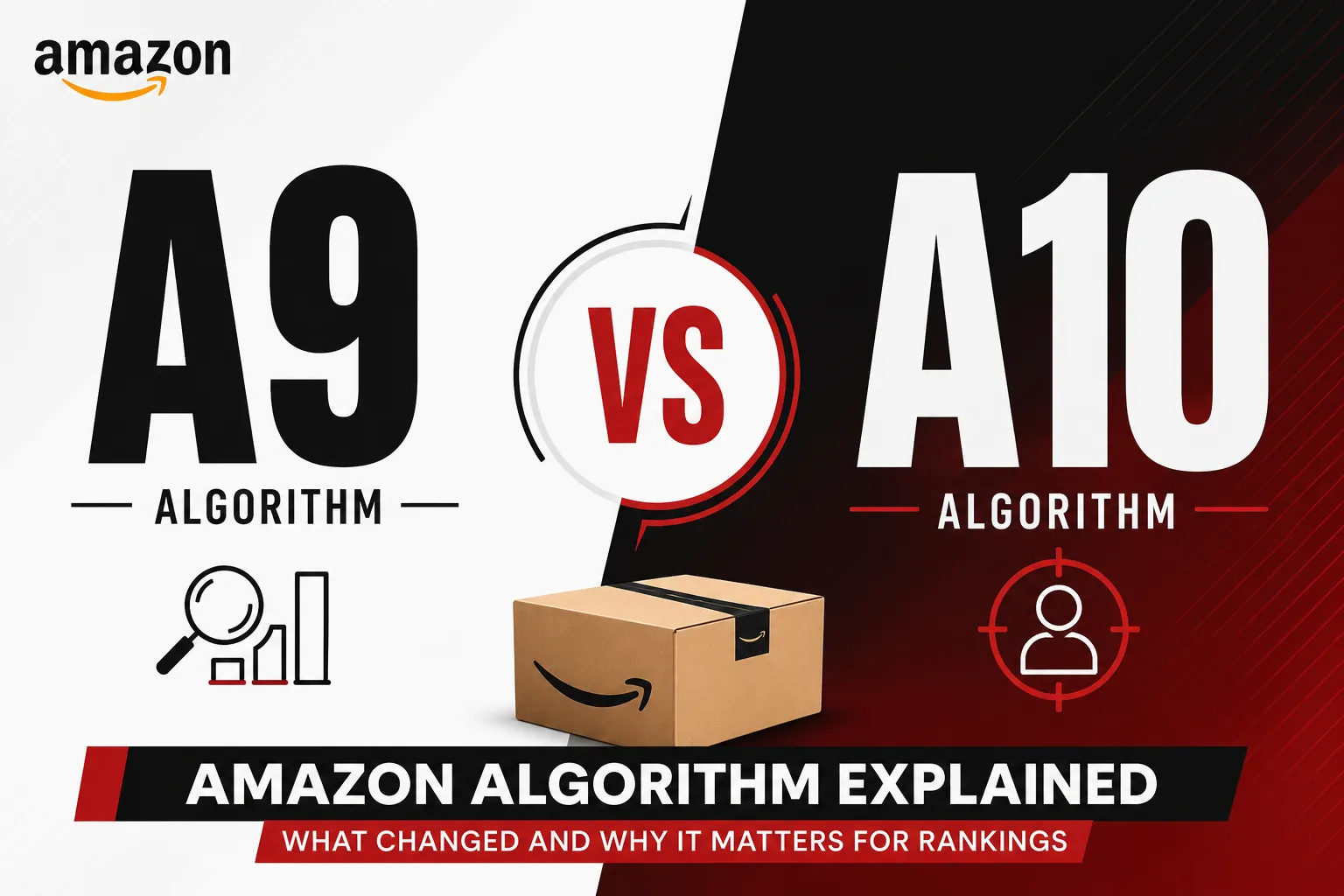
For years, Amazon sellers operated under one ranking system — A9. It was built around keyword relevance and sales velocity, and the playbook was straightforward: rank for the right keywords, drive sales, win the BuyBox. That world is over. Amazon's ranking system has evolved into what the seller community calls A10 — a fundamentally different algorithm that weighs new signals, punishes old tactics, and rewards behaviour A9 never measured. If you are running 2022 playbooks in 2026, you are losing ground every day without knowing why. Here is what actually changed, why it changed, and how to win under the new rules.
01 A Quick History — Where A9 Came From
A9 was the name of Amazon's product ranking algorithm developed by its A9.com subsidiary (now A2Z). It launched in the mid-2000s as a relatively simple system: match the customer's search query to product listings, then rank those matches by sales velocity. If a product sold more than its competitors for a given keyword, it ranked higher.
For a long time this worked. Amazon was a smaller marketplace, the competition was thinner, and ranking was largely a function of keyword optimization plus driving sales through PPC. Most ranking strategies were variations of the same recipe — optimize listings for relevant keywords, run aggressive PPC to generate ranking-velocity sales, and let the algorithm reward you for converting traffic.
02 Why A9 Stopped Working
By the early 2020s, A9 was being aggressively gamed. Sellers used review manipulation, ranking services, super URL tricks, off-platform launch services with deeply discounted products, and other tactics that drove sales velocity without representing genuine customer demand. The algorithm rewarded velocity regardless of source, which created a marketplace where ranking was increasingly disconnected from product quality.
At the same time, Amazon faced two strategic pressures. First, customers were increasingly buying through external traffic sources (Google, social media, influencers) where Amazon had no direct visibility. Second, Amazon needed to deprioritize sellers who relied entirely on Amazon PPC and reward sellers who brought outside traffic to the marketplace — because external traffic is more profitable for Amazon than recycling internal traffic through ads.
03 What "A10" Actually Means
Amazon has never officially confirmed the name "A10" — it is a term the seller community uses to describe the evolved ranking system. What we know for certain is that since 2019-2020, Amazon has progressively rolled out changes that shift weight away from PPC-driven sales velocity and toward signals that indicate real customer demand and seller authority.
The key shift is this: not all sales are weighted equally any more. A sale that originates from organic search inside Amazon is worth less to the algorithm than a sale that originates from a Google search or a direct external link. A sale from a long-tenured, high-feedback seller is worth more than a sale from a brand-new account. This single shift has reshaped everything about how serious sellers approach Amazon ranking.
04 The New Ranking Factors That Actually Matter
Based on what the data shows across our managed accounts and the broader seller community, here are the ranking factors that carry the most weight under the current algorithm. The order matters — these are roughly ranked by influence.
- Conversion rate — the single most important factor. High conversion rate signals a strong listing-to-buyer match.
- Off-Amazon traffic that converts — Google, social, influencer, email traffic that lands on Amazon and buys. Weighted heavily.
- Sales velocity from organic search — sales driven by your organic ranking. Compounds positively.
- Direct traffic — customers typing in your brand or product directly. Strong authority signal.
- Seller authority — account age, feedback rating, performance metrics, brand registry status.
- Internal sales (PPC) — still counts but much less than before. Cannot rank a product on PPC alone any more.
- Review velocity and rating — recent review activity matters more than total review count.
- Click-through rate from search — main image quality and price competitiveness drive this.
- Stay time on listing — bounce-back to search hurts ranking; engaged shoppers help it.
- Add-to-cart rate — even without purchase, ATC signals product interest.
05 The Off-Amazon Traffic Revolution
The single biggest change between A9 and the current algorithm is the weighting of off-Amazon traffic. Under A9, all sales were created equal. Under A10, a sale that originates from a Google search or an Instagram link carries significantly more ranking weight than the same sale generated through Amazon PPC.
Amazon's reasoning is strategic. Sellers who can bring outside buyers to Amazon are more valuable to Amazon's long-term growth than sellers who simply convert existing Amazon traffic. By weighting external traffic more heavily, Amazon incentivises the behaviour it wants — sellers actively marketing their products outside Amazon and bringing new customers into the ecosystem.
The practical implication: Amazon brands that rely 100% on Amazon PPC are losing ranking ground to brands running concurrent Meta Ads, Google Ads, influencer partnerships, and content marketing that drives external clicks to Amazon. The brands that win now are the ones treating Amazon as one channel in a multi-channel strategy, not as a closed ecosystem.
A brand running $5,000/mo on Amazon PPC alone vs the same brand splitting $3,000/mo Amazon PPC + $2,000/mo Meta Ads driving to Amazon. The second brand will outrank the first within 60-90 days even with lower total ad spend — because the external traffic is weighted more heavily.
06 Why Conversion Rate Is Now The Single Most Important Metric
Under A9, sales velocity was king. Under A10, conversion rate has overtaken it as the most predictive ranking factor. The logic is straightforward — sales velocity can be manufactured through aggressive PPC bidding or external promotions. Conversion rate is harder to fake. If 15% of the shoppers who view your listing buy your product, that is a strong signal that your listing matches buyer intent better than competitors. The algorithm rewards that match aggressively.
This is why listing optimization has become a higher-leverage activity than PPC management. A listing with a 12% conversion rate will outrank a listing with a 6% conversion rate even if the second listing has 2x the PPC spend. The relationship is not linear — small conversion rate improvements compound into dramatic ranking improvements over 60-90 days.
07 Seller Authority — The Trust Layer A9 Did Not Have
The current algorithm meaningfully weighs the seller behind the listing. Account tenure, feedback rating, brand registry status, account health metrics, IPI score, and seller performance history all influence ranking. This is why brand-new accounts struggle to rank in competitive categories even with great listings — the algorithm is hedging against unknown sellers until they accumulate authority signals.
The corollary is that established sellers in healthy account standing have a real ranking advantage that compounds over time. This is one reason why selling a single brand long-term tends to outperform launching and abandoning many brands in series — the seller authority you build on each ASIN carries forward to future ASINs under the same brand.
08 Why PPC Alone Cannot Rank Products Anymore
The most common mistake we see from sellers who learned Amazon in 2019-2021 is over-reliance on PPC for ranking. Under A9, you could rank a product to page 1 through sheer PPC volume — drive enough sales velocity for your target keyword and ranking followed automatically. Under A10, this no longer works at the scale it used to.
Amazon now caps how much ranking benefit you can earn from PPC-driven sales relative to organic and external-driven sales. Sellers running pure PPC strategies typically hit a ceiling around page 2 for competitive keywords and cannot break into the top 10 organic positions regardless of spend. The only way through that ceiling is to add external traffic, improve conversion rate, and build seller authority.
09 The Practical 2026 Optimization Playbook
Given what the current algorithm rewards, here is the concrete playbook we use for ranking listings in 2026. Apply these in order — each compounds on the previous.
- Fix conversion rate first — main image, title, price competitiveness, A+ Content. Target 10%+ for most categories.
- Run aggressive PPC in launch phase — first 30-60 days. The goal is data and initial ranking, not ROAS.
- Add external traffic by day 60 — Meta Ads, Google Ads, or influencer partnerships directing to your Amazon listing.
- Build review velocity — automated follow-up emails, Amazon Vine if eligible, customer service that prevents bad reviews.
- Maintain seller account health — fast response times, low defect rate, zero policy violations.
- Refresh keywords quarterly — competitor landscape shifts; your keyword strategy must shift with it.
- Build the brand — Storefront, A+ Content, Brand Stories. Brand authority compounds into ranking authority.
- Track external traffic in Brand Analytics — Amazon Attribution reveals which external sources drive ranking-positive sales.
10 Common Misconceptions About A10
The seller community has spread a few myths about A10 that need correcting.
Myth: A10 punishes PPC. Reality: A10 weights PPC sales less heavily than before, but does not punish them. PPC is still essential — it just cannot do the entire job alone.
Myth: External traffic always boosts ranking. Reality: External traffic boosts ranking only if it converts. Sending unqualified traffic from cheap clicks hurts your conversion rate and damages ranking. Quality matters more than volume.
Myth: You need to be Brand Registered to compete under A10. Reality: Brand Registry helps but is not strictly required. Sellers without Brand Registry can still rank — they just face higher friction on certain tools (A+ Content, Sponsored Brands).
Myth: A10 is a fixed system. Reality: Amazon updates the algorithm continuously. What we call "A10" is really a moving target — best practices in early 2026 may shift again by late 2026.
11 The Future — Where Amazon's Algorithm Is Heading
Based on the direction of the last 24 months, here is where the algorithm is likely heading. AI-personalized rankings are becoming more individualized — what one shopper sees for a query may differ from what another sees based on browsing history, past purchases, and predicted preferences. Voice and Alexa-driven shopping is becoming a separate ranking signal. Visual search (uploading a photo to find similar products) is starting to affect which listings get surfaced. Sustainability and brand purpose metrics are quietly entering the algorithm for certain categories.
The brands preparing for this future are doing three things consistently — investing in brand-building beyond product listings, optimizing for AI-friendly product information (structured data, clean attributes, complete content), and treating Amazon as the storefront of a larger brand rather than a standalone sales channel.
12 What This Means for Your 2026 Amazon Strategy
If you are managing existing listings, audit them against the A10 ranking factors above. Most listings are over-indexed on keyword stuffing and PPC spend, and under-indexed on conversion rate optimization and external traffic. Shifting that balance is where the ranking gains live in 2026.
If you are launching new products, plan from day one for an external traffic component — even a small one. Brands that launch with Amazon PPC plus a Meta retargeting campaign plus an influencer partnership see meaningfully faster ranking trajectories than brands that launch with PPC alone.
⌖ The Bottom Line
A9 was a sales-velocity algorithm. A10 is a conversion-and-authority algorithm. The sellers who adapt to that shift will dominate their categories for the next several years. The sellers who keep running 2022 playbooks will quietly slide down the rankings without understanding why.
Amazon is not going back to A9. The direction of travel is clear — more weight on real customer demand signals, more weight on external traffic and brand authority, less weight on raw PPC velocity. Build your strategy around where the algorithm is going, not where it was.
Find out exactly where your listing stands under A10
Skill Zone audits your listing against every current ranking factor — conversion rate, external traffic alignment, seller authority signals, keyword coverage. Free 30-minute session, no obligation, clear action plan.