
Zeenat Mazhar has led 41+ successful product launches with an 85% success rate. Book a free 30-minute session to map your launch from sourcing to first 100 organic sales.
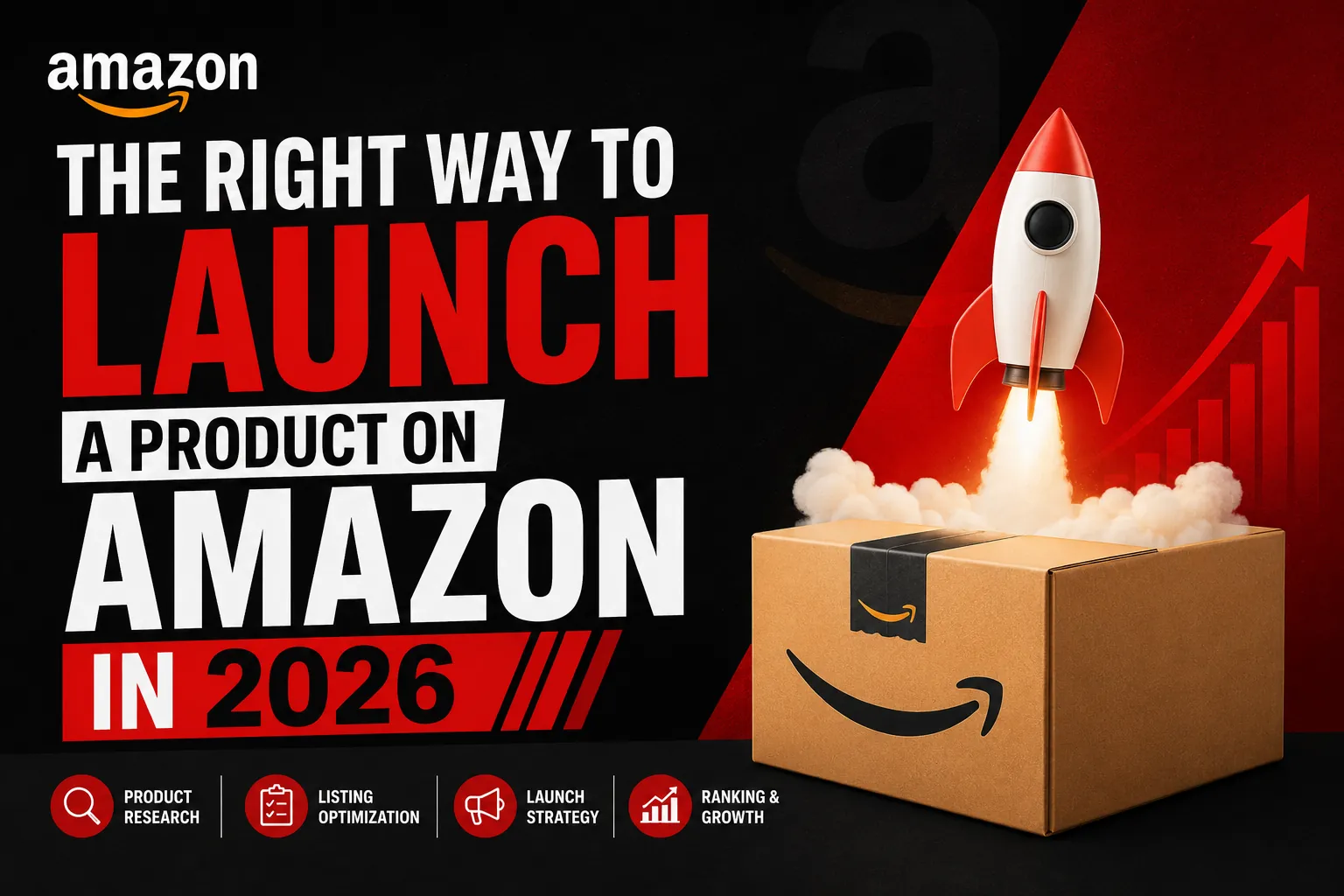
Launching a product on Amazon in 2026 is harder than it was three years ago and easier than it was ten. Competition has grown enormously in most categories, but the playbook for ranking, reviews, and external traffic has matured to the point where a disciplined launch can hit profitability within 90 days for the right product. This is the complete launch playbook we use at Skill Zone — refined across 41+ private label launches with an 85% success rate. Every step here exists because skipping it has killed launches we have seen up close.
01 Why Most Amazon Launches Fail
The single biggest reason Amazon launches fail is product selection. Roughly 60-70% of failed launches were doomed at the moment the founder picked the product, before any other mistake was made. Common product-pick failures: chasing trending products without checking sustained demand, picking categories dominated by entrenched brands with thousands of reviews, choosing products with margins too thin to support PPC during launch, or selecting products that look great in spreadsheet research but have hidden issues like high return rates or seasonal demand collapse.
The other 30-40% of launch failures come from execution mistakes: launching with weak listings, underspending on PPC in the first 30 days, ignoring reviews as a strategic asset, running launches without external traffic, or running out of inventory at the worst possible moment. Each of these is preventable with discipline, but each one is also surprisingly common even among experienced sellers.
02 The Pre-Launch Foundation
Before you order inventory, before you build a listing, before you do anything else, you need the foundational pieces in place. Skipping these creates expensive headaches that block your launch later.
- US LLC or LTD registered with EIN and tax interview completed.
- Amazon Seller Central account approved and verified — allow 2-3 weeks for non-US founders.
- US bank account linked (Mercury, Wise or Payoneer if you are foreign-owned).
- Trademark filed — required for Brand Registry, which unlocks A+ Content and brand protection.
- Inventory budget — minimum 3x your first PO cost to cover launch PPC and Q2 restock.
- Product liability insurance — required by Amazon once you cross $10K/month.
If any of these are missing when you start your launch, you will hit roadblocks that delay your timeline by weeks or months. Sort the foundation first.
03 Product Research Done Right
The criteria below filter out roughly 95% of product ideas. The 5% that survive are the candidates worth pursuing further.
- Monthly search volume: 5,000 - 50,000 for your primary keyword. Below 5K is too small. Above 50K is too competitive for a first launch.
- Top-10 review counts: No single competitor in the top 10 has over 1,500 reviews. Above this, the market is "review-locked" and breaking in costs too much.
- Top-10 monthly revenue: Average $8K-30K per top seller. Below $8K means not enough demand to share. Above $30K usually means dominant brands.
- Margin potential: 30%+ net margin after FBA fees, referral fee, and 25% PPC of revenue. If you cannot model 30%, the product is not worth launching.
- Differentiation: at least one meaningful improvement over the current top sellers — better materials, better packaging, better bundle, missing feature.
- Seasonality check: Google Trends shows year-round demand with no extreme seasonal collapse.
- Return rate risk: categories like apparel, electronics with complex setup, or fragile items carry higher return risk that erodes margins.
Use Helium 10 Black Box, Jungle Scout, and manual category browsing to find candidates. Then validate each candidate against the criteria above. Most founders rush past this phase because it is unglamorous — the disciplined ones know it is where launches succeed or fail.
04 Sourcing & Supplier Strategy
Once you have a validated product, sourcing properly determines your margin for the entire life of the product. Skipping steps here costs you for years.
Supplier discovery
Alibaba remains the most common starting point for global sourcing. Filter for Gold Suppliers with Trade Assurance, 4+ years on the platform, and verified factories (not trading companies, unless the trading company has clear advantages). Request at least 3-5 quotes per product to benchmark pricing.
Sample evaluation
Always order samples from at least 3 suppliers before placing a production order. Pay for samples — free samples often come from trading companies that are not the actual manufacturer. Inspect physically, test functionality, compare to competitor products you bought separately. The sample stage is where you catch quality issues that would otherwise destroy your reviews.
MOQ and pricing negotiation
First-order MOQ is usually 300-500 units for most physical products. Negotiate this down if your budget is tight. Negotiate packaging and customization separately from unit cost — bundle pricing usually hides margin the supplier can give up. Always ask for the price at 1K, 5K, and 10K units even if you are ordering smaller — sets your reorder pricing strategy.
Quality inspection
Hire a third-party inspection service (AsiaInspection, V-Trust, QIMA) for your first production run. Costs $300-500 and saves you from receiving a shipment of defective product that destroys your launch. Non-negotiable for first-time sellers.
05 Brand and Packaging That Converts
Brand and packaging are not optional cosmetic add-ons — they directly drive conversion rate, which directly drives ranking. A product with a strong brand identity and well-designed packaging converts 20-40% better than the same product with generic branding, all else equal.
The minimum viable brand identity for launch: a clean logo, a coherent colour palette (2-3 colours), one consistent typography family, and packaging that looks deliberate. You do not need a $10K brand identity package for your first launch, but you do need something better than a Fiverr logo and brown corrugate.
Packaging counts heavily because it shows up in your main image and your unboxing experience. Buyers judge product quality from packaging quality. Invest in proper packaging design even if it adds $0.50-1.00 per unit — the conversion rate lift usually pays for it 3-5x over.
06 Listing Build for Launch Velocity
Your listing is your storefront and your salesperson. Every element either lifts conversion or kills it. There are no neutral elements.
Main image
The single highest-leverage element in your entire listing. Compliant white background (RGB 255,255,255). Product fills at least 85% of frame. Hero angle that makes the product look the most impressive. If unsure, test 2-3 variants and pick the winner by click-through rate.
Title
Primary keyword first. Brand + primary keyword + key feature + secondary keyword + use case. Avoid stuffing. Read aloud — if it sounds like a robot wrote it, rewrite.
Bullet points
Five bullets, each addressing a specific buyer concern. Benefit first, feature second. Each bullet covers 1-2 secondary keywords. First two characters capitalised. Avoid all-caps spam.
Images 2-7
Infographics that explain features, dimensions, comparisons. Lifestyle shots showing the product in use. One image addressing a specific objection (size confusion, material quality, etc.). Mobile-first design — most buyers shop on phones.
A+ Content
If Brand Registered, build a comprehensive A+ Content section before launch. Comparison charts, brand story modules, feature breakdowns. A+ Content adds 8-15% to conversion rate on average. Worth doing properly.
Backend search terms
Fill all 250 bytes with keywords that do not appear in your visible copy. Misspellings, synonyms, Spanish translations, alternative names. Free indexing space — do not waste it.
07 The Launch PPC Strategy
PPC in the first 30 days is not about profit — it is about data collection and ranking velocity. The mistake new sellers make is targeting low ACOS in week one. The right strategy is the opposite — bid aggressively, gather search-term data, harvest converting keywords into structured campaigns.
- Day 1: Launch Auto campaign — broad targeting at competitive bids. Goal: discover keywords Amazon thinks fit your product.
- Day 1: Launch Broad and Phrase match campaigns on your top 10-15 keywords from research. Bid at the top of suggested range.
- Day 1: Launch Exact match campaigns on your top 5 keywords. Aggressive bids — you want top-3 placement during the launch window.
- Weeks 1-2: Daily search-term report review. Identify converting search terms. Add them as negative keywords in Auto/Broad campaigns. Add them as targets in Exact match campaigns.
- Weeks 3-4: Start optimizing bids. Lower bids on terms not converting. Raise bids on terms converting profitably.
- Days 30-60: Transition from launch mode to optimization mode. Target ACOS shifts from "data-gathering" to "profitable scaling."
Realistic ACOS expectations during launch: 60-100% in weeks 1-2, 40-70% in weeks 3-4, 25-50% by day 60, 15-30% by month 4-6 once organic ranking compounds.
08 Reviews — How to Get Your First 25 Without Breaking Amazon's Rules
Review velocity in the first 30-60 days is critical. Listings under 10 reviews struggle to convert even with great traffic. The methods that work in 2026 and stay within Amazon's terms of service:
- Amazon Vine (if Brand Registered) — invite up to 30 reviewers from Amazon's Vine program. Costs $200 enrolment + free product. Typically generates 15-25 honest reviews within 30 days. The single fastest legitimate way to build initial review velocity.
- Automated follow-up emails through Amazon's Request a Review button or tools like FeedbackWhiz, Helium 10 Follow-Up. Send 1 review request 5-7 days after delivery. Get 4-8% review rate.
- Insert cards — packaging inserts that prompt buyers to leave a review. Must comply with Amazon's strict rules: no incentives, no discounts conditional on positive reviews, no review redirects.
- Excellent product + excellent customer service — the long-term review engine. Respond to every customer message within 24 hours. Fix problems before they become 1-star reviews.
What does NOT work in 2026: review manipulation services, family/friend reviews from the same address, incentivised reviews on Facebook groups, refund-for-review schemes. All of these violate Amazon TOS and have killed accounts permanently in recent crackdowns.
09 External Traffic During Launch — The 2026 Differentiator
Under Amazon's current algorithm, external traffic to your listing carries more ranking weight than the same volume of internal Amazon traffic. Brands that launch with concurrent external traffic outrank brands that launch with PPC-only by a meaningful margin within 60-90 days.
The minimum viable external traffic plan for a launch: $500-1,500/month on Meta Ads driving cold traffic to your Amazon listing or a landing page that redirects. Use Amazon Attribution to track which external sources convert. Layer in influencer partnerships if budget allows — even one or two micro-influencer posts in your category can drive measurable launch velocity.
This is the single biggest differentiator between 2026 launches that scale and launches that plateau at page 2 of search results. If your launch budget allows it, plan external traffic from day one.
10 The 30 / 60 / 90 Day Launch Timeline
Concrete expectations for what should happen and when during a properly executed launch.
Days 1-30 — Velocity Phase
Aggressive PPC across all match types. External traffic campaigns live. Vine submission active. Daily search-term report review. Target: 50-150 organic + paid sales, 15+ reviews, ranking for top 5-10 long-tail keywords on page 1.
Days 31-60 — Optimization Phase
Shift PPC from data-gathering to profitability. Optimize bids based on conversion data. Continue building reviews. Listing iteration based on conversion data (test new main images, refine bullets). Target: 200-400 cumulative sales, 30-50 reviews, page 1 for 2-3 primary keywords.
Days 61-90 — Scaling Phase
Profitable PPC, expanding to Sponsored Brands and Sponsored Display. Review velocity sustained. Organic ranking compounding. Target: First profitable month at the unit-economics level. ACOS in 25-40% range. Sustained 10-20 daily sales.
11 Inventory Planning — Do Not Run Out
Running out of stock during launch is one of the most expensive mistakes in Amazon selling. You lose ranking, your reviews stop coming in, and recovering takes 2-3x longer than the stockout itself. Plan inventory aggressively.
The math: typical Asia-to-FBA timeline is 30-45 days from production order to inventory available for sale. That means your reorder decision needs to be made when you have 45-60 days of inventory remaining at projected velocity. Most sellers wait too long because the cash conversion cycle is brutal — but stocking out costs more than carrying inventory.
Practical rule: reorder when on-hand inventory equals your last 30 days of sales velocity, every time. This builds a safety buffer that absorbs velocity spikes during ranking jumps.
12 When to Hire Help vs Do It Yourself
If your launch budget is under $10K total (inventory + ads + creative), you will need to do most of this yourself. The learning compounds for future launches. Allocate 3-6 months to learn the craft before expecting a profitable launch.
If your launch budget is $15K+ and you want to maximize the odds of profitability within 90 days, hiring expert help on listing optimization, launch PPC, and creative pays back many times over. The right agency or specialist usually costs $2K-5K for a launch package and saves you from the expensive mistakes that kill self-managed first launches. At Skill Zone we run launch services within our Amazon Private Label package — typically going from product validation to first profitable month in 90-120 days.
⌖ The Bottom Line
Amazon launches in 2026 reward preparation and punish improvisation. The product you pick matters more than anything else. The listing you build determines whether your traffic converts. The PPC you run in the first 30 days determines whether you collect enough data to ever turn profitable. The reviews you build in the first 60 days determine whether you can rank organically. The external traffic you layer in determines whether you break through the algorithm's ranking ceiling.
Done well, an Amazon launch is one of the most scalable ecommerce models available today. Done poorly, it is one of the most expensive ways to lose money quickly. The difference is discipline at every step — and the discipline is what this guide is for.
Ready to launch your next Amazon product?
Skill Zone has led 41+ successful product launches with an 85% success rate. Book a free 30-minute strategy session and walk away with a clear launch roadmap tailored to your specific product and budget.