
Zeenat Mazhar has taken accounts from 120% ACoS down to 14%. Book a free 30-minute audit to find out exactly what is dragging your ACoS up and how to fix it.
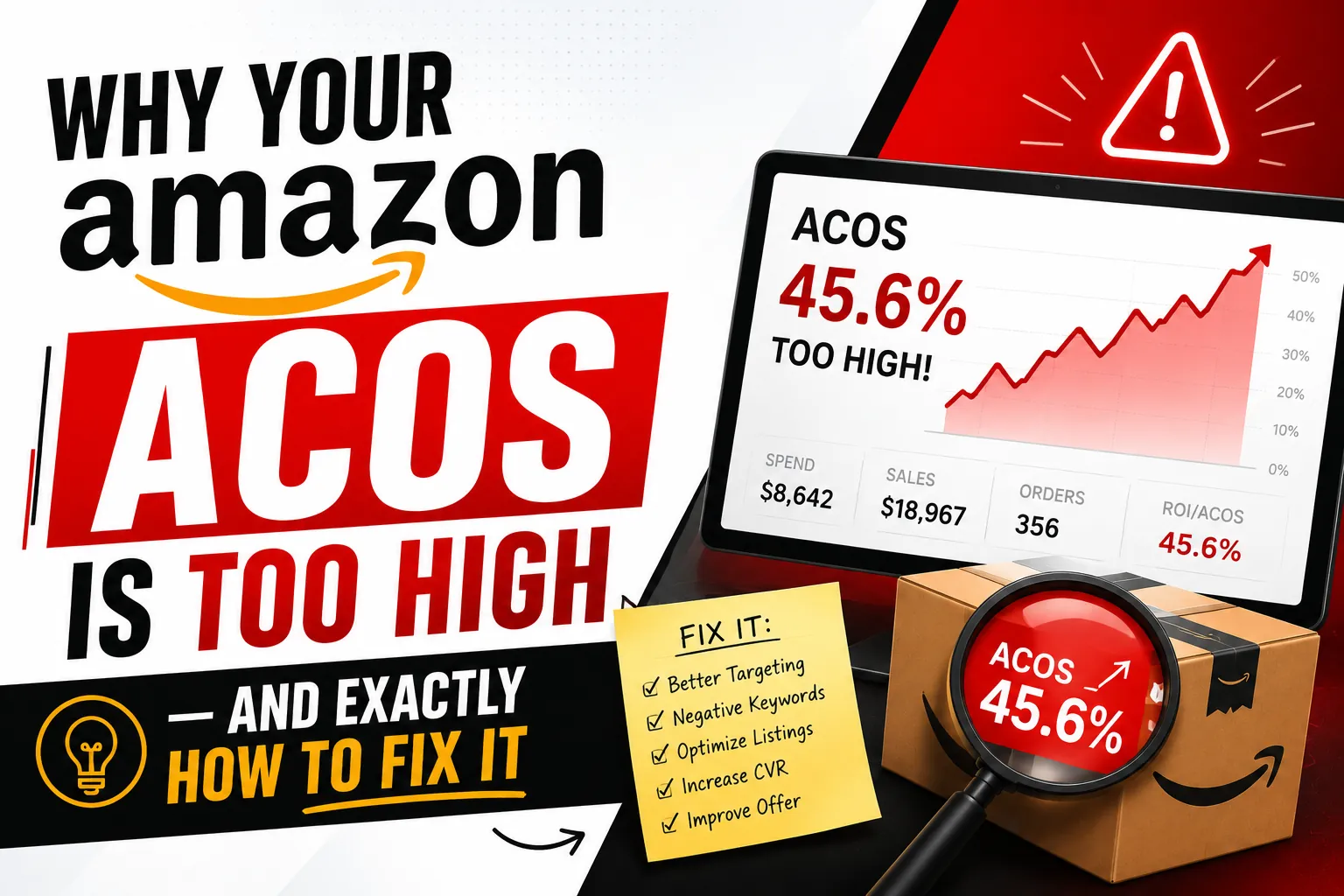
Most sellers approach high ACoS as a bidding problem. They lower bids, then lower them again, then watch sales collapse without ACoS improving meaningfully. This pattern repeats because the diagnosis is wrong. High ACoS that persists for more than 60 days is almost never a bid problem — it is a structural problem with campaign architecture, search term hygiene, listing conversion rate, or category-fit. This guide walks through the real causes of high Amazon ACoS and the systematic fix we use to take accounts from 80%+ down to the 15-25% range that profitable PPC needs to live in.
01 What ACoS Actually Measures (And What It Doesn't)
ACoS — Advertising Cost of Sales — measures what percentage of ad-attributed revenue went to ad spend. A 30% ACoS means you spent $30 to generate $100 in ad-attributed sales. Most sellers stop here, but two other metrics matter more for long-term strategy.
TACoS (Total ACoS) measures ad spend against your total revenue (ad + organic). This is the metric that actually reflects whether your PPC is supporting profitable business growth. A 20% ACoS with rising TACoS means your organic sales are eroding even though your ad campaigns look efficient. A 35% ACoS with falling TACoS means your ads are driving meaningful organic growth that compounds over time.
Break-Even ACoS is the ACoS at which your unit economics turn negative. If your product has a 35% profit margin after FBA fees, your break-even ACoS is 35%. Anything below that is profitable on the marginal sale. Anything above is losing money per click. Knowing your break-even is the only way to make rational bid decisions.
02 Why High ACoS Is Usually a Strategy Problem, Not a Bid Problem
The single most common mistake we see is sellers blaming high ACoS on bidding. They lower bids, sales drop, ACoS stays the same or gets worse, and they panic. The reason this happens is that bid manipulation only changes ACoS at the margin. If your campaign structure is broken, your listing converts poorly, or you are bidding on terms that cannot convert for your product, no amount of bid optimization will fix it.
The honest diagnosis: most underperforming PPC accounts have 3-5 structural issues stacked together. Fixing one helps a little. Fixing all of them produces the dramatic drops from 80% ACoS to 25% that look like magic but are actually systematic engineering work.
03 The 7 Real Reasons Your ACoS Stays High
Across hundreds of PPC audits we have done at Skill Zone, the causes of stubbornly high ACoS cluster into seven categories. Most accounts have 2-4 of them simultaneously.
- Letting Auto campaigns run without aggressive negative keyword harvesting — you are paying for irrelevant traffic Amazon thinks is relevant.
- Mixing match types in a single campaign — broad, phrase, and exact all competing in the same campaign produces unpredictable spend.
- Poor listing conversion rate — traffic arrives, fails to buy, ACoS rises. PPC cannot fix bad listings.
- Scaling spend on campaigns that have not proven profitability — pouring budget into unprofitable structures multiplies the loss.
- No campaign segmentation — branded, generic, competitor, defensive all jumbled together with no separate strategy.
- Bidding on keywords with mismatched intent — ranking for terms that drive clicks but rarely convert because the search intent does not fit your product.
- Ignoring placement modifiers — top-of-search converts 2-4x better than rest-of-search. Most sellers leave placement modifiers at default 0%.
04 Search Term Reports — Your Most Important Diagnostic Tool
The single most powerful tool for fixing high ACoS is your search term report. Download it for the last 60 days. Filter for any search term with spend over $5 and zero conversions. Add every single one of those as a negative exact keyword in the campaign or ad group where they appeared. This single action typically drops ACoS by 15-30% within two weeks because you stop paying for traffic that has already proven it does not convert for your product.
The pattern most accounts show: 20-30% of total PPC spend is going to search terms that have never converted and never will. Eliminating that wasted spend mechanically improves ACoS without changing anything else. This is the lowest-effort, highest-impact PPC fix available and most sellers neglect it.
Every week, pull last week's search term report. Filter spend > $3 with zero conversions. Add as negative exact. Filter spend > $10 with conversions but high ACoS (above 2x your break-even). Add as negative exact too. This routine alone keeps wasted spend from creeping back in.
05 The Negative Keyword Strategy That Actually Works
Most sellers think of negative keywords as a one-time setup task. In reality, negative keyword maintenance is the single highest-leverage ongoing PPC activity. Amazon's algorithm constantly tries new search terms in your Auto and Broad campaigns — your job is to harvest the converting ones into Exact match campaigns and block the non-converting ones permanently.
The negative keyword categories that matter most: brand-relevant but intent-wrong terms (e.g., "amazon prime" or "cheap" for a premium product), related product terms (e.g., "iphone case" when you sell phone chargers), research-intent terms (e.g., "how to use," "reviews," "vs"), and price-mismatch terms (e.g., "free," "under 20" when your product is $80).
06 Campaign Structure That Lowers ACoS
The campaign structure most accounts run is essentially random — campaigns built up over time without strategic separation. The structure that drives lower ACoS is deliberate and segmented by purpose.
- Auto campaigns — for discovery only. Modest budget. Harvest search terms weekly into exact match.
- Broad match campaigns — for testing new keyword themes at scale. Moderate budget. Harvest converters into exact match.
- Exact match campaigns — for proven converters only. Higher budget. Tighter bids. Profitability is the goal here.
- Branded campaigns — defending your brand name from competitors bidding on it. Cheap, high ROAS, mandatory.
- Competitor ASIN campaigns — targeting your competitors' product pages directly. High intent, controllable spend.
- Category ASIN campaigns — targeting category browsing pages. Lower conversion but cheaper clicks.
- Sponsored Brands campaigns — driving brand awareness and capturing branded search.
Each campaign type has its own budget, its own bid strategy, and its own success metrics. Mixing them together makes optimization impossible because the data is too messy to interpret.
07 Match Type Strategy: When to Use Broad, Phrase, and Exact
Match types should never mix in a single campaign. The standard structure is one campaign per match type per keyword group. This separation matters because each match type has different conversion behaviour and needs different bid strategy.
Broad match casts the widest net — Amazon shows your ad for related terms it thinks fit. Highest spend volatility. Use for keyword discovery only, with aggressive negative harvesting.
Phrase match tightens the targeting — ads show for variations that contain your keyword phrase. Better controlled than broad but still casts a wider net than exact. Useful middle ground.
Exact match shows your ad only for that specific keyword or close variations. Tightest control, highest conversion rate, highest cost per click. This is where the bulk of your profitable spend should live after the first 90 days.
08 Bid Strategy and Placement Modifiers
Amazon offers four bid strategies: dynamic up-and-down, dynamic down only, fixed bids, and rule-based. The right choice depends on the campaign type. Dynamic down only is the safest default for most campaigns — Amazon lowers your bid when a click is less likely to convert. Dynamic up-and-down can boost performance on proven converters but increases spend volatility. Fixed bids give you maximum control but require active management. Rule-based is newer and works well for sophisticated portfolio management.
Placement modifiers are an underused lever. Top-of-search placement converts 2-4x better than rest-of-search in most categories. Set placement modifier to +50% to +100% for top-of-search on your proven exact-match campaigns. The cost per click increases but conversion rate increases more, so ACoS often drops despite higher CPCs.
09 Listing Conversion Rate — The Most Underrated ACoS Lever
If your listing converts at 5%, you need 20 clicks per sale. At $1 per click, that is $20 ad spend per sale. If your sale price is $40, ACoS is 50%. Now lift conversion rate to 10% — you need 10 clicks per sale, $10 ad spend per sale, ACoS drops to 25%. Same bids, same keywords, ACoS cut in half. This is why listing optimization has more leverage over ACoS than PPC management does.
The conversion rate levers that matter most: main image quality (the single biggest factor for click-to-purchase), title clarity (does the title match what the customer was searching for), price competitiveness (Amazon's algorithm penalises listings priced significantly above category average), review count and rating (under 50 reviews is a conversion killer), and A+ Content quality (Brand Registered listings with proper A+ Content convert 8-15% better).
10 Dayparting — Free ACoS Reduction Most Sellers Ignore
Not all hours of the day convert equally. Pull your campaign data by hour and day-of-week. Most categories show clear patterns — for example, ACoS might be 60% between midnight and 6am and 22% between 10am and 7pm. The sellers running 24/7 at flat bids are paying premium prices during low-conversion hours and missing opportunity during peak hours.
Implement dayparting by adjusting bids hourly. Reduce bids by 30-50% during low-conversion hours. Boost bids by 20-50% during high-conversion hours. Amazon now supports rule-based bid adjustments natively, and third-party tools like Helium 10 ADS, Pacvue, and Perpetua make this easier. The ACoS improvement is typically 10-20% from dayparting alone — entirely "free" because total spend stays the same, just reallocated to better hours.
11 Branded Campaigns — The Most Profitable ACoS in Your Account
Branded campaigns (campaigns targeting your own brand name) are almost always the most efficient ACoS in any account. People searching for your brand name are already high-intent buyers — they convert at high rates, the keyword is cheap, and competitors will steal these searches if you do not defend them.
If you do not have a dedicated branded campaign running with ACoS under 10%, set one up today. The cost is minimal, the ROAS is exceptional, and it prevents competitors from running ads on your brand name and converting buyers who specifically searched for you. Brand defense is mandatory once you have brand recognition.
12 The Realistic Timeline for ACoS Improvement
Sellers expect ACoS to drop overnight when they make changes. The honest timeline for sustainable ACoS improvement is 4-8 weeks for visible change, 3-6 months for transformation. Here is what to expect week by week.
Weeks 1-2 — Quick wins. Negative keyword purge, campaign cleanup, brand defense setup. Expect 15-25% ACoS reduction.
Weeks 3-4 — Structure work. Campaign segmentation, match type separation, placement modifier optimization. Another 10-15% improvement.
Weeks 5-8 — Listing optimization impact. If conversion rate improvements are implemented, ACoS keeps falling as the same spend converts more efficiently.
Months 3-6 — Organic ranking lift. As PPC efficiency drives ranking improvements, organic sales grow, TACoS drops, and PPC becomes a smaller percentage of revenue.
Months 6-12 — Sustained performance. Well-managed accounts at this stage typically run 15-25% ACoS with TACoS around 8-15%. This is the profitable zone where Amazon PPC compounds rather than drains.
⌖ The Bottom Line
High ACoS is almost always fixable. The fix is rarely about bidding — it is about campaign architecture, search term hygiene, listing conversion rate, and ongoing weekly maintenance. The accounts we have taken from 120% ACoS down to 14% did not get there through clever bid algorithms. They got there through systematic engineering of the underlying PPC structure and the listing it points to.
If you make the changes in this guide and your ACoS still does not drop within 60-90 days, the issue is probably category-fit or product-market-fit, not PPC. At that point the honest answer is sometimes to discontinue the product rather than continue paying to advertise a structurally unprofitable item. Knowing when to fix and when to fold is part of profitable Amazon selling.
Want to know exactly what is dragging your ACoS up?
Skill Zone audits your Amazon PPC account in detail — campaign structure, search term waste, listing conversion gaps, placement strategy. Book a free 30-minute session and walk away with a clear action plan to drop ACoS within 60 days.