
Zeenat Mazhar, CEO & Founder of Skill Zone, runs a free 30-minute strategy session to map exactly which agentic AI workflows can transform your operations in 2026.
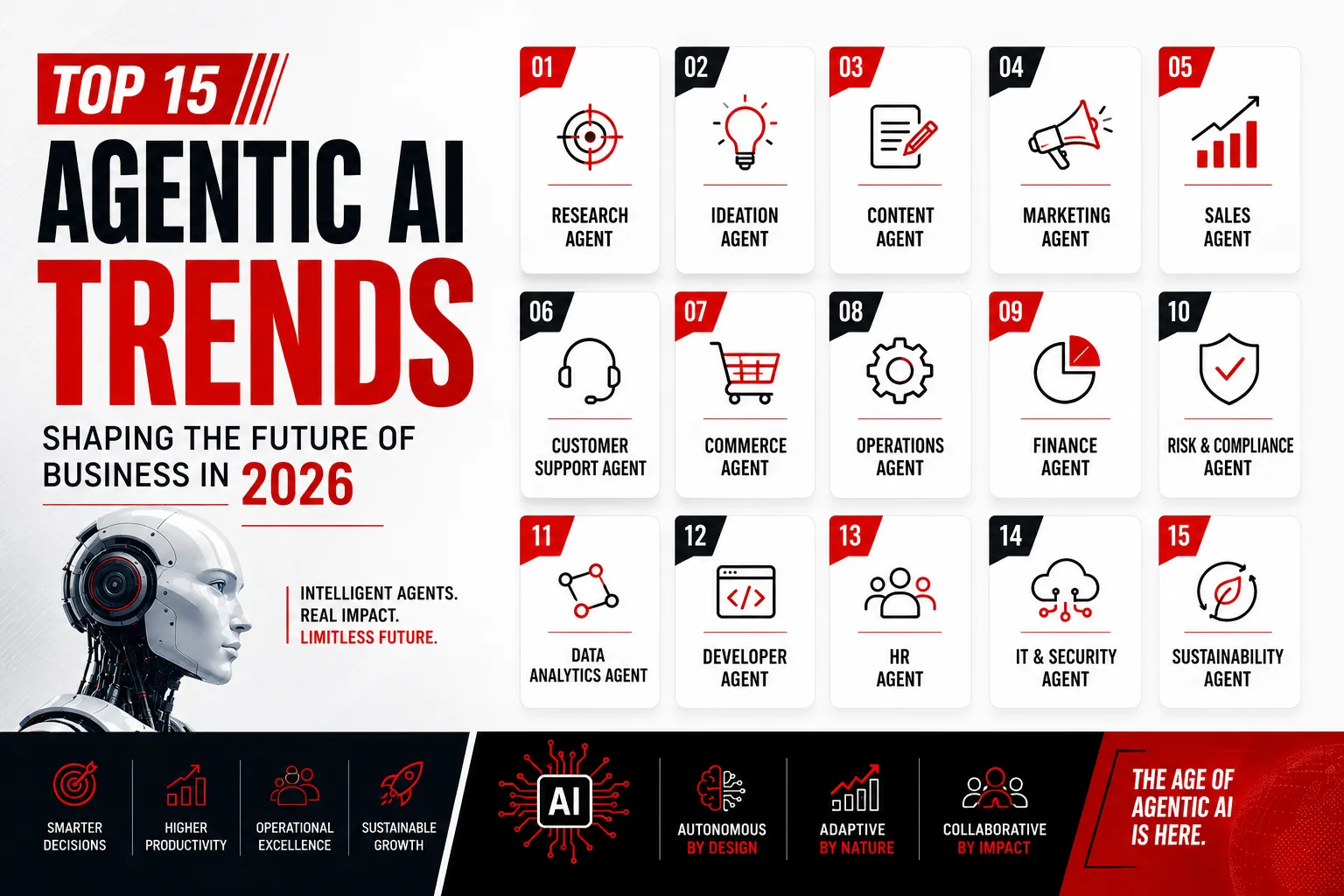
Most of the conversation about AI in 2025 was about chatbots. Most of the conversation in 2026 is going to be about agents — and that distinction matters more than most people realise. Chatbots answer questions. Agents take action. They decide, plan, execute and report back, often without a human in the loop at every step. That shift from passive AI to autonomous AI is the most consequential change happening in business technology this decade, and it is moving faster than the average leadership team is tracking. This guide walks through the 15 agentic AI trends that will define how serious businesses operate in 2026 — what each trend means, why it matters, and what you should actually do about it.
01 Multi-Agent Orchestration Becomes the Default
Throughout 2024 and most of 2025, the dominant model was a single AI agent handling a single task. By 2026 that is changing fast. The leading edge of enterprise AI is now built around teams of specialised agents working together — one researches, another writes, a third reviews, a fourth deploys. Each agent has a narrow role, a clear handoff protocol, and access to specific tools.
This matters because single-agent systems hit a complexity ceiling. Ask one agent to research a market, write a strategy doc, design a campaign and run the ads, and it loses coherence somewhere in the middle. Break the same job across four specialised agents with clean interfaces between them and the work actually ships.
The frameworks driving this — LangGraph, CrewAI, OpenAI's Swarm, Claude Code's sub-agent system — are still maturing, but the pattern is locked in. By the end of 2026, most production AI systems running in serious businesses will be multi-agent by default.
02 The Rise of the AI Workforce
For the first time, companies are not just automating tasks — they are deploying full AI employees that own a workflow end to end. The cleanest current examples sit in three categories: customer support agents that handle Tier 1 issues autonomously, sales development agents that prospect and qualify leads through to a meeting booking, and operations agents that run inventory, reordering and reporting without daily supervision.
The shift is psychological as much as technical. Companies that previously thought of AI as a productivity tool are now thinking of AI as headcount. That changes how you budget, how you measure ROI, and how you structure your team. An AI agent that closes 20 qualified meetings a month is not a $200 SaaS subscription — it is a $5,000 sales rep that does not sleep.
Stop asking "what tools can my team use to be more productive" and start asking "what roles can I fill with agents." The answer will surprise you.
03 Agentic Browsing and Autonomous Web Navigation
OpenAI's Operator, Anthropic's computer use, Google's Project Mariner — every major AI lab now ships agents that can navigate the web like a human. They open browsers, click buttons, fill forms, scrape data, complete checkouts. In 2025 this was a demo. In 2026 it is becoming infrastructure.
The business implications are significant. Lead research that used to take a junior analyst eight hours now runs in twenty minutes. Competitor monitoring, price tracking, supplier verification, regulatory compliance checks — all of these are being rebuilt as agentic browsing workflows. The companies that figure out where this is reliable and where it still needs human checks will compress operational costs in ways their competitors cannot match.
04 Vertical Agents Beat Horizontal Platforms
The first generation of AI agents tried to be everything to everyone. The 2026 generation is sharply vertical-specific — agents built for a single industry, trained on that industry's data, integrated with that industry's tools.
You can see this clearly in legal (Harvey, Spellbook), sales (11x, Artisan), recruiting (Bland, Mercor), healthcare (Hippocratic, Suki) and ecommerce (Klarna's AI assistant, Shopify Sidekick). Each one is narrow enough to be genuinely better than a generic agent at its specific job, while integrating natively with the systems that vertical actually uses.
For business buyers this means the playbook is shifting from "pick the best general AI" to "pick the best agent for our specific workflow." For founders, it means the next wave of AI-native unicorns will not look like ChatGPT — they will look like vertical SaaS with agents inside.
05 Memory and Continuous Learning Become Real
Until late 2025, most AI agents were essentially amnesiacs. Each conversation started from scratch. By 2026, persistent memory is becoming a baseline expectation. Agents remember past interactions, learn from outcomes, build internal models of your business, your customers, and your preferences over time.
The technical foundation is a combination of vector databases (Pinecone, Weaviate, Turbopuffer), knowledge graphs, and increasingly sophisticated retrieval-augmented generation patterns. The user experience is an agent that feels like it actually knows you — because it does. It remembers that your top SKU is seasonal, that your VIP customers expect a specific response style, that last quarter's PPC strategy did not work and why.
This is the difference between an AI that needs to be briefed every morning and an AI that briefs you.
06 Voice-First Agents Reach Production Quality
Voice AI has been promised for a decade and consistently disappointed. In 2026 it is finally good enough to actually deploy. The trio of breakthrough models — OpenAI's Realtime API, ElevenLabs Conversational, Google's Gemini Live — now produce voice interactions that feel natural enough for real customer-facing use.
The places this is landing first: inbound and outbound calls for high-volume use cases. AI receptionists, appointment booking, lead qualification, customer service triage, restaurant reservations. The economics are extreme — a voice agent that costs $0.20 per call versus a human contact center agent at $5-15 per call. For SMBs, this is making 24/7 phone coverage economically viable for the first time.
07 Agentic Commerce — AI That Buys and Sells on Your Behalf
One of the most underrated shifts of 2026 is the emergence of agent-to-agent commerce. Stripe, Visa, Shopify and OpenAI have all rolled out infrastructure for AI agents to make purchases — autonomously, with spending limits, payment methods and audit trails.
The implications are still settling, but the direction is clear. On the consumer side, your AI assistant books your flights, reorders your supplies, comparison-shops your subscriptions. On the business side, procurement agents negotiate with vendor agents, inventory agents trigger reorders without human approval, marketplace agents bid in ad auctions in real time.
For ecommerce brands specifically, this raises a new strategic question that did not exist a year ago: how do you optimise your storefront not just for human shoppers, but for AI agents shopping on their behalf? The answers are still being worked out, but structured data, clean APIs and agent-readable product information are clearly going to matter more.
08 The "AI in the Loop" Model Replaces "Human in the Loop"
The dominant 2024 design pattern was human in the loop — AI suggests, human approves, human executes. The dominant 2026 pattern is inverting: AI in the loop. The agent runs the workflow. The human reviews exceptions, edge cases, and high-stakes decisions only.
This is a profound shift in how work gets organised. It means humans become exception handlers rather than primary executors. It means most of your team's time gets reallocated from doing the work to defining the rules and reviewing the edge cases. It means software interfaces evolve from "tools you use" to "dashboards that show you what the agent did."
Companies that get this transition right will run with 30-50% smaller operational teams. Companies that resist it will be outcompeted on cost and speed within 18 months.
09 Tool Use Becomes Sophisticated and Reliable
The breakthrough underneath most agentic AI is tool use — the agent's ability to call external functions, APIs and software reliably. In 2024 this worked maybe 60-70% of the time. In 2026, with models like Claude Sonnet 4.6 and GPT-5, tool calling success rates are reaching the 95%+ range needed for production deployment.
This is what makes the rest of agentic AI possible. An agent that fails 30% of its API calls is a novelty. An agent that succeeds on 95%+ of them is operational infrastructure you can actually rely on. We are crossing that threshold this year, which is why so many things in this list are suddenly viable at the same time.
10 Cost-Efficient Small Models Power the Long Tail
Not every agent task needs frontier intelligence. A surprising amount of business automation works perfectly with much smaller, much cheaper models — Llama 3.3 8B, Claude Haiku 4.5, Gemini Flash, Mistral Small. These models cost 50-200x less per token than frontier models and run fast enough for real-time use.
The 2026 production pattern is tiered model routing. A cheap, fast model handles 80% of requests. A mid-tier model handles complex requests. The flagship frontier model only gets called for the hardest 5% of cases. This pattern lets companies deploy agentic AI at scale without burning through margin on inference costs.
11 Self-Improving Agents and Reinforcement Learning Loops
The frontier of agentic AI research right now is agents that genuinely improve from experience. Not just memory — actual learning. Agents that try a workflow, observe what worked, adjust their approach, and perform measurably better next time without a human retraining them.
The technical foundation is reinforcement learning from execution outcomes — the same family of techniques that produced ChatGPT-level reasoning gains in the o1 and o3 model lineages, now applied to agent behaviour rather than chat responses. Companies like Adept, Reka and most major AI labs are working on this. By late 2026, expect to see the first commercial products where the agent you deploy on day one is meaningfully smarter on day ninety because it has been learning from your specific workflows.
12 Agentic Security and Autonomous Threat Response
The same agentic patterns showing up in marketing and sales are arriving in cybersecurity. Defensive agents that monitor traffic, detect anomalies, isolate compromised systems and respond to threats — at machine speed, 24/7, without waiting for a human analyst.
This is necessary because the offensive side is also going agentic. AI-powered attacks are being deployed at scale, scanning for vulnerabilities and adapting faster than human defenders can respond. The only viable counter is agentic defence operating at the same speed and scale. CrowdStrike, Sentinel One, Microsoft Security Copilot — all major security vendors now ship agent-powered defence as core product, and adoption is accelerating fast in 2026.
13 Agentic Developer Tools Reshape Software Engineering
If you are building software in 2026 and not using agentic developer tools, you are already behind. Claude Code, Cursor, Devin, GitHub Copilot Workspaces — these are not autocomplete tools any more. They are AI software engineers that take a task description, plan the work, write the code, run the tests, fix the failures, and submit a pull request.
The productivity gain for engineering teams is something between 2x and 10x depending on the task category. Front-end work, internal tools, data pipelines, refactoring — all of these are seeing massive speedups. The bottleneck in software development is shifting from "writing the code" to "deciding what to build and reviewing what was built."
14 Agentic Search and the End of the Blue Links
Google AI Mode, ChatGPT Search, Perplexity, Claude with web search — every meaningful interface for finding information now uses agents to research, synthesise and answer. The classic ten blue links experience is becoming a small minority of total search behaviour.
For businesses this is rewriting SEO from the ground up. The question is no longer "do we rank in the top three results" — it is "does the AI cite our content as a source when it answers questions in our category?" The fundamentals of good SEO still apply, but new layers are emerging: structured data for AI extraction, clear authorial credentials, explicit answers to common questions, and content optimised for citation rather than clicks.
The brands that adapt SEO strategy to this new reality in 2026 will dominate organic discovery for the rest of the decade. The brands that do not will quietly disappear from where customers actually look for answers.
15 Governance, Auditability and Trust Become Competitive Advantages
The final trend is what separates the agentic AI deployments that scale from the ones that get pulled back six months in. Governance. Every autonomous agent in production needs clear answers to: what is it allowed to do, what is it not allowed to do, how do we audit what it did, how do we override it when it goes wrong, and who is accountable when it does.
The companies leading on this — Anthropic, Microsoft, OpenAI with their enterprise offerings, plus specialised governance vendors like Credo AI and Fairly AI — are building the infrastructure for accountable autonomous action. Comprehensive logs, decision audit trails, policy-based action limits, kill switches, human escalation paths.
This is not glamorous, but it is essential. In regulated industries especially, the difference between a deployable agent and a science project is the governance layer around it. By late 2026, "show me your AI audit logs" will be a standard procurement question, and companies that cannot answer it will lose deals to companies that can.
⌖ What You Should Actually Do About This
If you read this whole list and felt overwhelmed, that is the correct reaction. The honest summary is that agentic AI is changing more about how businesses operate than any technology shift since the internet — and the timeline is faster than most leadership teams are prepared for.
The practical move for most businesses in 2026 is not to deploy all 15 of these at once. It is to pick the one or two trends most relevant to your specific business model, run a real pilot, learn what works in your context, and scale from there. Customer support agents are an easy first pilot for most companies. Sales development agents are the next most common. After that, the right answer depends on your business.
The mistake to avoid is doing nothing. The companies that are still in a "wait and see" posture by Q4 2026 will be at a serious structural disadvantage by 2027. Agentic AI is no longer experimental — it is operational. The question is not whether you will use it, but whether you will lead with it or be forced into it later when your competitors already have a multi-year head start.
Ready to deploy agentic AI in your business?
Skill Zone helps founders, operators and enterprise teams pick the right agentic workflows for their stage — and build them properly so they actually work in production. Book a free 30-minute strategy call with our CEO and walk away with a clear 90-day AI roadmap.