
Zeenat Mazhar runs a free 30-minute session to map your AI roadmap — assess current maturity, identify the highest-leverage first pilot, and outline a realistic 12-month deployment plan.
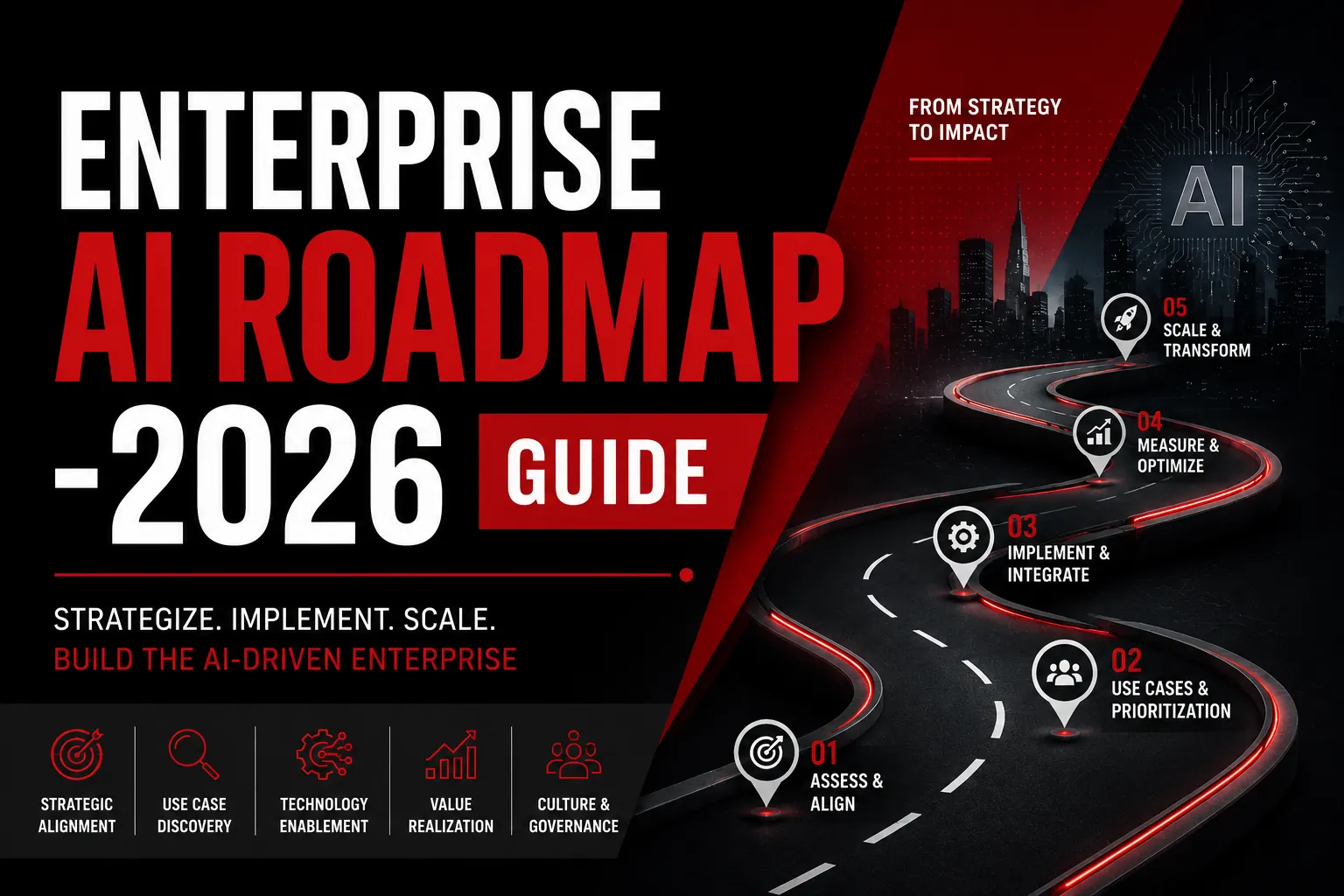
If your organisation is somewhere between "we should probably be using AI" and "we have ten pilots none of which are in production," this guide is for you. The most common pattern in enterprise AI right now is enormous interest, scattered experimentation, and very little operational deployment. The reason is rarely the technology — it is the absence of a coherent roadmap that takes an organisation from curiosity to AI-native operations in deliberate stages. This is that roadmap, built from what is actually working in enterprises that have deployed AI successfully versus the much larger group that has spent budget without seeing returns.
01 Why Most Enterprise AI Projects Fail
Roughly 70-80% of enterprise AI initiatives never reach production, according to research published across 2024 and 2025 by Gartner, McKinsey and BCG. The failure pattern is remarkably consistent. Organisations get excited about AI, run a handful of experimental pilots, find the pilots are interesting but hard to integrate with real workflows, and lose momentum before anything ships to production users.
The root causes are not technical. The technology works. The failures stem from missing foundational layers — no clear strategy connecting AI to business outcomes, no governance framework, fragmented data, no defined ownership, and no clear path from pilot to production. Organisations that have these foundations in place ship AI to production successfully. Organisations that do not, spend money and get nothing operational.
The roadmap below is structured to put the foundation in place first and then build deployment capacity on top of it. Each stage assumes the previous one is solid. Skipping ahead is the failure pattern.
02 The Five Stages of Enterprise AI Maturity
Every organisation moves through five distinct maturity stages on the way to AI-native operations. The boundaries between stages are not sharp, but the gating criteria are clear. Honest self-assessment matters here — most organisations overestimate their maturity by about one stage.
- Stage 1: Foundation — data, infrastructure, governance and strategy are in place. No production AI yet.
- Stage 2: First Wins — 1-3 low-risk pilots running in production with measurable ROI.
- Stage 3: Production Operations — AI embedded in core workflows across one or two departments. Real users, real budget.
- Stage 4: Cross-Functional Scale — AI deployed across multiple departments with shared infrastructure and governance.
- Stage 5: AI-Native Transformation — AI is the default way new workflows get designed. The org operates fundamentally differently than it did pre-AI.
Most mid-sized organisations in 2026 are stuck between Stage 1 and Stage 2 — they have enthusiasm and pilots but not production. Most large enterprises are between Stage 2 and Stage 3 — they have isolated production deployments but no cross-functional scale. Stage 5 organisations are still rare and tend to be either AI-native startups or genuinely transformed traditional firms.
03 Stage 1 — Foundation: The Work Most Organisations Skip
Foundation is the least exciting and most important stage. Organisations that skip it eventually have to retrofit it, usually at much higher cost than doing it properly upfront. The foundation has four components.
Data readiness
AI runs on data. If your data is fragmented across silos, inconsistently formatted, undocumented or inaccessible without IT tickets, AI deployment will be painful. Foundation work here means establishing a data catalog, basic data quality standards, and accessible data infrastructure that AI projects can build on without rebuilding from scratch each time.
Infrastructure decisions
Choose your AI platform strategy now. Are you building on Azure (OpenAI partnership), AWS (Bedrock), Google Cloud (Vertex AI), or a multi-cloud strategy? Are you using vendor APIs, fine-tuned open-source models, or both? Get the high-level architecture decisions made before pilots begin so you are not stuck rebuilding infrastructure six months in.
Governance framework
Define what AI can and cannot do in your organisation. Acceptable use policies, data privacy requirements, model risk management, audit logging, human oversight rules. Get the policy framework signed off by legal, compliance and leadership before any AI touches production. Retrofitting governance is exponentially harder than designing it in from the start.
Strategy and ownership
Name an AI leader. Define which business outcomes AI is targeting (cost reduction, revenue growth, customer experience). Set a 12-24 month vision that connects AI investment to those outcomes. Without explicit ownership and outcome alignment, AI projects drift into expensive experimentation with no accountability for delivery.
04 Stage 2 — First Wins: Choosing the Right Pilot
Once the foundation is in place, the goal of Stage 2 is to ship 1-3 production AI deployments with measurable ROI. The single biggest determinant of success here is pilot selection. Most failed AI initiatives are not failures of execution — they are failures of pilot choice.
A good first AI pilot has these characteristics: high volume + repetitive + measurable + low risk. Customer support ticket triage. Document classification. Internal knowledge search. Marketing copy generation. Sales lead qualification. These types of workflows have clear before/after metrics, low downside if something goes wrong, and enough volume that even modest efficiency gains produce visible ROI.
Bad first pilots have the opposite profile — low volume, high stakes, hard to measure, public-facing. Customer-facing chatbots for nuanced support. Medical or legal advisory systems. Anything that requires regulatory approval before production deployment. These can succeed eventually but are wrong choices for your first deployment.
The most reliable Stage 2 ROI in 2026 comes from three pilot categories: customer support automation, internal knowledge agents, and sales/marketing content generation. Each typically pays back in 6-12 months with manageable execution risk.
05 Stage 3 — Production Operations
Stage 3 is the transition from "we have a pilot that worked" to "AI is embedded in how this department operates." The key shift is from project mindset to operations mindset. Pilots are temporary; production systems are permanent and require ongoing maintenance, monitoring, and improvement.
The technical disciplines that matter most in Stage 3 — model monitoring, performance evaluation, prompt versioning, cost tracking, escalation handling, retraining cadence. These are not glamorous but they are what separates production AI from impressive demos. Most enterprises underestimate the operational overhead of running AI in production by roughly 2-3x.
Organisationally, Stage 3 requires defined roles. Who owns the AI system? Who is on-call when it breaks? Who decides when to retrain? Who approves prompt changes? These questions need answers before deployment, not after the first production incident.
06 Stage 4 — Cross-Functional Scale
Stage 4 is where AI becomes infrastructure. Multiple departments — marketing, sales, customer service, operations, finance, HR — all deploying AI solutions on shared platforms with shared governance. This is the stage where centralised AI capability becomes more valuable than departmental AI experimentation.
The organisational structure shifts. Most successful Stage 4 organisations establish an AI Center of Excellence — a small central team that maintains shared infrastructure (model catalog, evaluation frameworks, governance tooling), enforces standards, and provides specialist support to department teams who own their specific use cases. This balances central efficiency with departmental ownership.
The economics also change at Stage 4. The cost of incremental AI deployment drops dramatically because shared infrastructure amortises across many use cases. ROI calculations shift from per-project to portfolio-level — some deployments will outperform expectations, others underperform, and the portfolio as a whole needs to produce returns.
07 Stage 5 — AI-Native Transformation
Stage 5 is rare and transformative. The organisation no longer treats AI as a tool to add to existing workflows — instead, new workflows are designed AI-first from the start. The default question becomes "how would an AI handle this" rather than "how do we add AI to what humans currently do." Headcount, organisational structure, KPIs, and budget all shift accordingly.
Stage 5 organisations typically operate with smaller human teams handling more output. Senior roles shift from execution to exception-handling, judgement calls, and AI oversight. New AI-native roles emerge — prompt engineers, AI orchestration specialists, evaluation engineers. The economics often become category-defining — competitors operating at Stage 3 cannot match the cost structure or output speed of a Stage 5 competitor in the same space.
Realistic timeline expectation: organisations starting from Stage 1 in 2026 should expect 3-5 years to reach Stage 5 if they execute well. Most will plateau at Stage 3 or 4, which is still a meaningful competitive position.
08 The Governance Layer That Holds It All Together
Governance is what separates AI deployments that scale from AI deployments that get pulled back six months in. Every production AI system needs clear answers to: what is it allowed to do, what is it not allowed to do, how do we audit what it did, how do we override it when it goes wrong, and who is accountable when it does.
The minimum viable governance framework includes: acceptable use policies (what AI can be used for in your organisation), data classification rules (which data can and cannot be sent to AI systems), model risk management (how you evaluate AI models before production), monitoring and logging (audit trails for every AI decision), human-in-the-loop requirements (which decisions require human approval), and incident response (what to do when AI behaves unexpectedly).
In regulated industries especially, the difference between a deployable AI system and a science project is the governance layer around it. By late 2026, "show me your AI audit logs" is a standard procurement question, and organisations that cannot answer it lose deals to organisations that can.
09 People and Skills — Building the AI-Capable Workforce
Hiring strategy matters as much as technology strategy. The roles that drive successful enterprise AI deployment are not just AI specialists. The biggest gaps in most organisations are AI-literate domain experts (marketers who can prompt-engineer, customer service leaders who can design AI escalation flows, ops managers who can specify AI workflows).
The 2026 hiring mix that works: 1 AI strategy leader + 2-3 ML/AI engineers for foundational infrastructure + AI-literate practitioners embedded in each business unit who can specify and own AI use cases in their domain. This last group is harder to find but more important than the first two combined. Domain experts who understand AI capabilities consistently outperform AI specialists who do not understand the domain.
10 Budget and Timeline Reality
Realistic 12-month budget expectations for a mid-sized enterprise starting from Stage 1:
- Foundation (Stage 1): $50K-150K — data infrastructure improvements, governance framework development, strategy work.
- First pilots (Stage 2): $30K-100K per pilot — implementation, infrastructure, vendor costs, ongoing API costs.
- Production operations (Stage 3): $50K-200K per deployed system per year — depending on usage volume and complexity.
- Specialised team: $200K-500K per year — at minimum, one senior AI engineer and one strategist.
Total first-year budget for a serious enterprise AI program: $400K-1.5M depending on scope. ROI typically materialises 12-18 months in for well-executed programs. Lower budgets are possible but slow the timeline meaningfully.
11 Common Pitfalls and How to Avoid Them
The seven mistakes we see most often in enterprise AI deployments.
- Skipping foundation work to ship pilots faster — pilots succeed but cannot scale because the infrastructure underneath is fragile.
- Choosing the wrong first pilot — high-stakes, hard-to-measure, public-facing pilots that consume budget and produce no clear ROI.
- No defined ownership — AI projects with no executive sponsor, no operating budget, no on-call rotation. They die quietly.
- Buying tools instead of building capability — the magic is in the workflow integration, not the vendor. Tools without capability produce nothing.
- Underestimating governance — assuming governance is something to add later. Retrofitting governance is dramatically more expensive than designing it in.
- Treating AI as IT — letting IT lead AI strategy. IT can implement, but business outcomes should drive what gets built.
- Stopping at Stage 2 — celebrating early pilots and never investing in production operations. Pilots that never reach Stage 3 are sunk cost.
12 Your 90-Day Starting Plan
If you are starting from zero and want a concrete plan for the next 90 days, here it is.
Days 1-30 — Foundation assessment. Audit current state of data, infrastructure, AI policies, and existing AI experiments. Identify gaps. Name an AI lead with executive sponsorship and an operating budget.
Days 31-60 — Strategy and pilot selection. Define 1-3 specific business outcomes AI will target in year one. Identify the single best first pilot — high volume, repetitive, measurable, low risk. Lock down vendor and infrastructure choices.
Days 61-90 — Pilot kickoff. Launch the first pilot with a defined success metric, a 6-week target deployment timeline, and a clear path from pilot to production if successful. Build the governance and operating framework in parallel with the pilot, not after it.
⌖ The Bottom Line
Enterprise AI in 2026 is no longer experimental. The technology works, the playbooks exist, and the organisations that have deployed it well are seeing real returns. What separates winners from losers is not budget or technology — it is discipline. Build the foundation properly. Choose pilots that can succeed. Invest in operations, not just experiments. Build governance from day one. Move through the maturity stages in order rather than skipping ahead.
Organisations that take this roadmap seriously will be operating very differently in 18-24 months than they are today. Organisations that keep doing scattered pilots without foundational work will still be in Stage 1 in two years, having spent budget and built nothing operational. The difference is execution discipline, not raw resources.
Ready to build a real enterprise AI roadmap?
Skill Zone helps enterprise teams move from scattered pilots to deployed AI infrastructure. Book a free 30-minute strategy session and walk away with a clear assessment of your current AI maturity stage and a tailored 12-month roadmap.