
Zeenat Mazhar runs a free 30-minute session to map your channel strategy — Amazon, Shopify or both. Based on your product, stage, and growth goals, you walk away with a clear recommendation.
This is the most common question we get from ecommerce founders. Should I sell on Amazon? Build a Shopify store? Do both? The honest answer depends on your brand stage, your product type, your budget, and your long-term ambition. There is no universally correct answer — but there is a wrong answer for each specific situation, and getting it wrong costs you 12-18 months of momentum. This guide breaks down the real economics, the customer ownership trade-offs, and the strategic decision framework for choosing the right channel in 2026.
01 The Question Every Product Brand Has to Answer
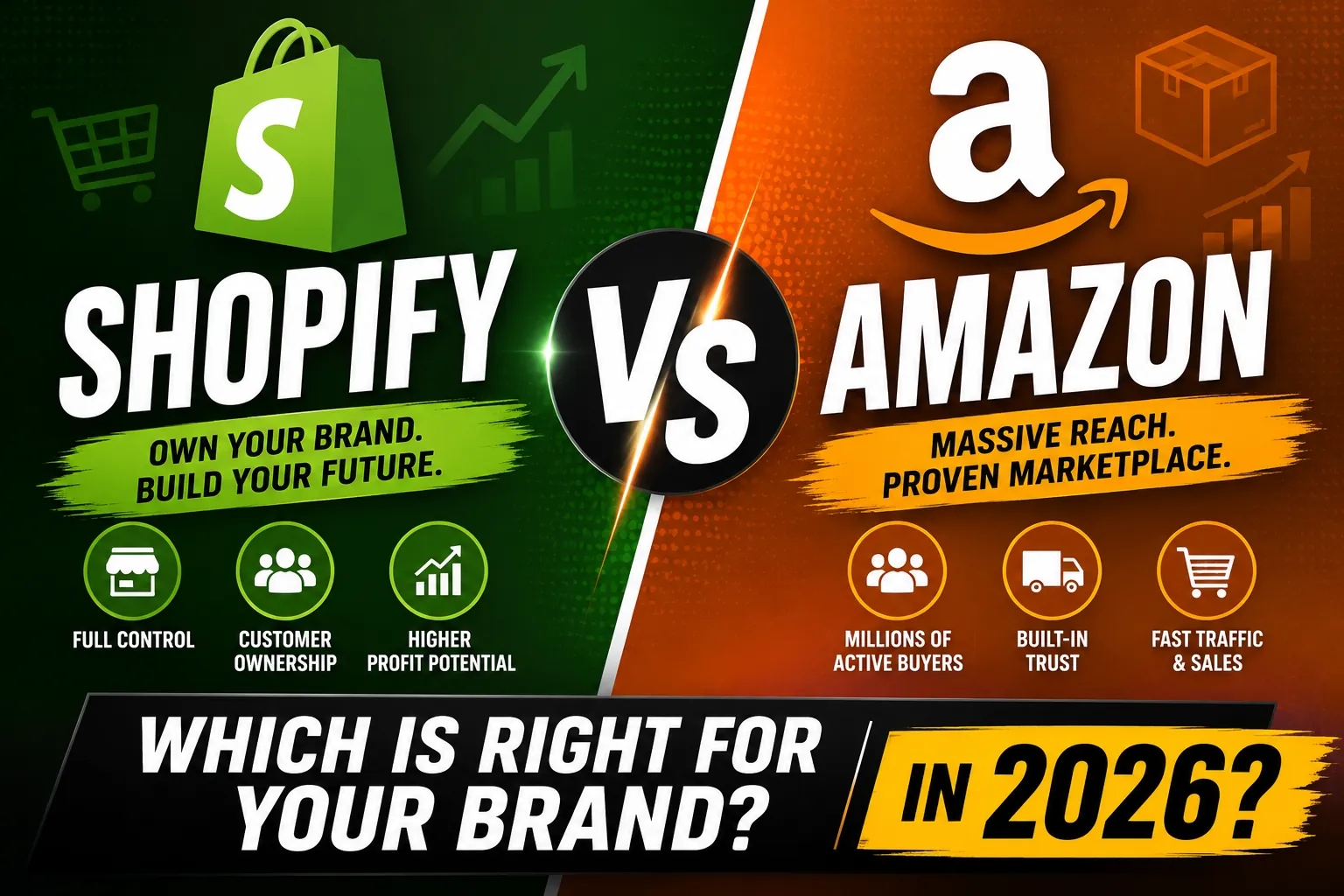
Amazon and Shopify are not really competitors — they solve different problems. Amazon gives you immediate access to active buyers but controls the customer relationship and takes a meaningful cut. Shopify gives you full control of the customer experience and the brand but requires you to bring your own traffic. Choosing between them (or both) comes down to a single strategic question: do you need immediate sales or do you need long-term brand equity?
Most founders need both eventually. The question is sequencing — which channel first, and when to add the second. Get the sequencing wrong and you either run out of cash before momentum builds (Shopify-first without sufficient ad budget) or you build revenue on a channel you do not own (Amazon-only without ever building brand equity outside the marketplace).
02 What Amazon Gives You — Built-in Demand at Scale
Amazon's single biggest advantage is buyer intent. The 300+ million active customers on Amazon are not browsing — they are shopping. The conversion rate on Amazon traffic is 3-5x higher than on cold paid traffic to a Shopify store. For physical products that fit Amazon's category mix, the marketplace is the fastest path to first revenue.
The other major benefits: FBA fulfilment (Amazon stores, picks, packs and ships for you), Prime eligibility (a meaningful conversion lift), built-in trust (buyers trust Amazon's return policy and fraud protection), and review infrastructure (social proof that compounds over time).
For product-based brands launching from scratch with limited marketing budget, Amazon is almost always the right first channel. You can validate product-market fit, generate revenue, and build review velocity in weeks rather than the months it takes to build Shopify traffic from zero.
03 What Amazon Takes — The Real Cost of Marketplace Access
Amazon's price for what it gives you is meaningful. The full cost stack on a typical Amazon sale includes referral fees (8-15% depending on category), FBA fulfilment fees ($3-6 per unit for most products), storage fees (monthly, with peak season surcharges), PPC spend (most products need 15-30% of revenue going to PPC), and occasional refund/return processing fees.
Add it all up and Amazon takes roughly 35-50% of gross revenue before you see a dollar. The remaining 50-65% needs to cover COGS, shipping inbound, packaging, and your profit margin. This is why Amazon products typically need 3-4x markup over COGS to be profitable, not the 2-2.5x that works on Shopify.
The bigger cost is intangible — Amazon owns the customer. You do not get the buyer's email address. You cannot remarket. You cannot build a subscription model easily. You cannot offer loyalty programs at scale. The customer belongs to Amazon, not to you.
Your entire business runs on rules someone else writes and can change without warning. Listings get suspended. Categories get gated. Algorithms shift. Sellers who built single-channel Amazon businesses have lost 50-90% of revenue overnight when policies changed. Channel diversification is risk management, not just growth strategy.
04 What Shopify Gives You — Full Ownership of Everything
Shopify gives you control. Your storefront, your branding, your customer data, your checkout experience, your email list, your loyalty program, your subscription model — all owned by you, indefinitely. This ownership is the foundation of long-term brand equity that cannot be replicated on a marketplace.
The financial benefits are real too. No referral fee on each sale (just payment processing at 2.9% + 30¢). Margin retention roughly 25-40% better than Amazon for the same product after factoring in marketplace fees and FBA. Repeat purchases happen on your terms — email marketing, retargeting, customer reactivation campaigns.
For brands with genuine brand differentiation, story-driven products, or any subscription/repeat-purchase model, Shopify enables business models that simply do not work on Amazon. A coffee subscription, a clothing brand, a beauty line with seasonal launches — these brands grow much better on Shopify than on a marketplace.
05 What Shopify Takes — You Must Build Your Own Traffic
Shopify gives you a storefront. Shopify does not give you customers. Every Shopify store starts at zero and stays there until the founder figures out how to drive traffic. This is the killing field — most Shopify stores never get profitable because the founder underestimated the cost and complexity of building a traffic engine from scratch.
The realistic monthly marketing budget to grow a new Shopify brand: $3,000-15,000+ per month across paid ads (Meta, Google, TikTok), influencer partnerships, SEO content, and email marketing. Most stores that fail underspent on paid acquisition or spent without strategy. Getting Shopify economics to work requires either a meaningful initial ad budget or an organic content engine that takes 6-12+ months to build.
The other reality: customer acquisition cost (CAC) on Shopify in 2026 is 2-4x what it was in 2020. Meta and Google have become more expensive. iOS tracking changes hurt attribution. The brands winning on Shopify in 2026 either have exceptional creative, strong word-of-mouth, or organic content strategies that reduce dependence on paid acquisition.
06 The Real Cost Comparison — Side by Side
For a hypothetical $40 product with $10 COGS, here is the realistic monthly economics on each channel at 200 sales/month.
Amazon
Revenue: $8,000. Referral fee (15%): -$1,200. FBA fees: -$1,000. PPC (25% of revenue): -$2,000. Storage and misc: -$200. COGS: -$2,000. Profit: $1,600 (20% margin).
Shopify
Revenue: $8,000. Payment processing (3%): -$240. Shopify subscription: -$80. Apps (Klaviyo, reviews, shipping): -$250. Paid ads (CAC of $20 = $4,000): -$4,000. Shipping (variable, factor into pricing): customer pays. COGS: -$2,000. Profit: $1,430 (18% margin).
The economics are surprisingly similar at small scale. The differences become dramatic at scale — Shopify margins improve significantly as repeat-purchase rates build and CAC drops with brand recognition. Amazon margins stay roughly fixed because the fees are non-negotiable.
07 Customer Lifetime Value — The Decisive Long-Term Metric
This is where the channels truly diverge. On Amazon, your average customer makes 1.3-1.5 purchases of your brand because Amazon controls the relationship and rarely brings them back to your specific listing. On Shopify, brands with good email marketing and loyalty programs see customer LTV of 3-5x first-purchase value within 24 months.
That LTV difference changes everything about how much you can afford to spend on customer acquisition. An Amazon-only brand cannot bid aggressively on customers because LTV barely exceeds first-purchase value. A Shopify brand with 3x LTV can afford to lose money on the first purchase to acquire customers who become profitable over their lifecycle. This is the entire DTC business model — and it does not work on Amazon.
08 Which Brands Should Start on Amazon
Amazon is the right starting channel if any of these apply.
- Limited launch budget (under $20K total) — Amazon's built-in demand stretches a smaller budget further than building Shopify traffic from zero.
- Physical product in a category Amazon already dominates (beauty, supplements, kitchen, home, fitness, electronics, etc.).
- Commodity-leaning product with thin differentiation — Amazon's search-driven model works well for "best X for under $30" queries.
- First-time founder learning ecommerce — Amazon teaches you product/listing/PPC discipline faster than Shopify forces you to learn marketing.
- No brand identity yet — Amazon does not require a strong brand to make sales. Shopify does.
09 Which Brands Should Start on Shopify
Shopify is the right starting channel if any of these apply.
- Existing customer base or audience — if you already have a following from social media, email, or a previous business, that traffic converts much better on Shopify.
- Subscription, repeat-purchase, or LTV-driven business model — coffee, supplements with refill cycle, beauty, pet food, etc.
- Strong brand-driven product with story, design language, or community — Amazon flattens brand premium; Shopify lets brand command pricing.
- Service business or digital product — Amazon is not the right marketplace for non-physical products in most cases.
- Significant ad budget ($5K+ monthly minimum) to build traffic in the first 90 days.
- Restricted on Amazon — some categories (CBD, certain supplements, certain electronics) cannot list on Amazon at all.
10 The "Both" Strategy That Most Successful Brands Adopt
The honest 2026 answer for most product brands is both — at the right stages. The sequence that works for most: launch on Amazon first, build to consistent $20K-50K monthly revenue, then launch Shopify funded by Amazon profits.
This sequence works because Amazon validates product-market fit fast and generates the cash flow needed to fund Shopify acquisition costs. Brands that try to launch both simultaneously usually underfund each channel and fail both. Brands that launch only on Amazon eventually plateau because they cannot escape the fee structure and customer ownership constraints. Brands that launch only on Shopify often burn through capital before reaching profitability.
The transition signal — Amazon revenue is consistent, you understand your unit economics, you have at least $10K monthly to spend on Shopify traffic without breaking your overall business. At that point Shopify becomes an accretive growth channel that builds the brand equity Amazon never gives you.
11 What Both-Channel Brands Get Right
The brands successfully running both channels treat them as complementary, not competing.
- Amazon = top-of-funnel for product discovery and trial.
- Shopify = relationship channel where you build LTV, run subscriptions, offer exclusives.
- Cross-channel pricing strategy — same headline price across channels (to avoid Amazon's price-matching), but Shopify offers exclusive bundles, subscriptions, and member benefits that justify direct purchases.
- Different SKUs where possible — Amazon-exclusive SKUs vs Shopify-exclusive SKUs to avoid direct competition.
- External traffic to Amazon early, to Shopify later — early Meta ads can drive to Amazon for ranking velocity, then transition toward driving brand traffic to Shopify as the brand matures.
12 The 2026 Bottom Line
Amazon and Shopify are tools that solve different problems. The strategic question is not "which is better" — it is "which problem am I solving first." If you need revenue fast and have a marketplace-friendly product, start Amazon. If you have audience, brand or budget and want long-term ownership, start Shopify. If you can afford patience and want maximum upside, start Amazon, build to scale, then add Shopify funded by Amazon profits.
The brands that lose are the ones that pick a channel for the wrong reasons — Shopify because "I do not want Amazon to take my margin" (without budget to drive traffic), or Amazon-only because "Shopify is too much work" (and never building brand equity). Channel choice is strategy. Channel commitment without strategy is gambling.
⌖ What We Do at Skill Zone
We run both channels for clients across multiple verticals. Our Amazon team handles private label launches, PPC management, listing optimization, and account growth. Our Shopify team builds premium branded storefronts — including 3D and cinematic experiences — designed for maximum conversion and brand equity. Clients running both channels typically see 40-60% more total revenue than single-channel competitors at the same total ad spend, because the channels reinforce each other in ways neither does alone.
If you are deciding between Amazon and Shopify for your next product launch, or if you are stuck on one channel and wondering whether to add the other, book a free strategy call. We will give you a clear, honest recommendation based on your specific product, stage, and goals — not a generic "do both" answer.
Not sure which channel is right for your brand?
Book a free 30-minute strategy call with Zeenat Mazhar and get a clear, honest recommendation based on your specific product, stage, and growth goals — no generic advice, no upsell pressure.